
Bitcoin and war correlation: Is It a Digital Gold or a Risky Asset?

Bitcoin and war correlation: Is It a Digital Gold or a Risky Asset?
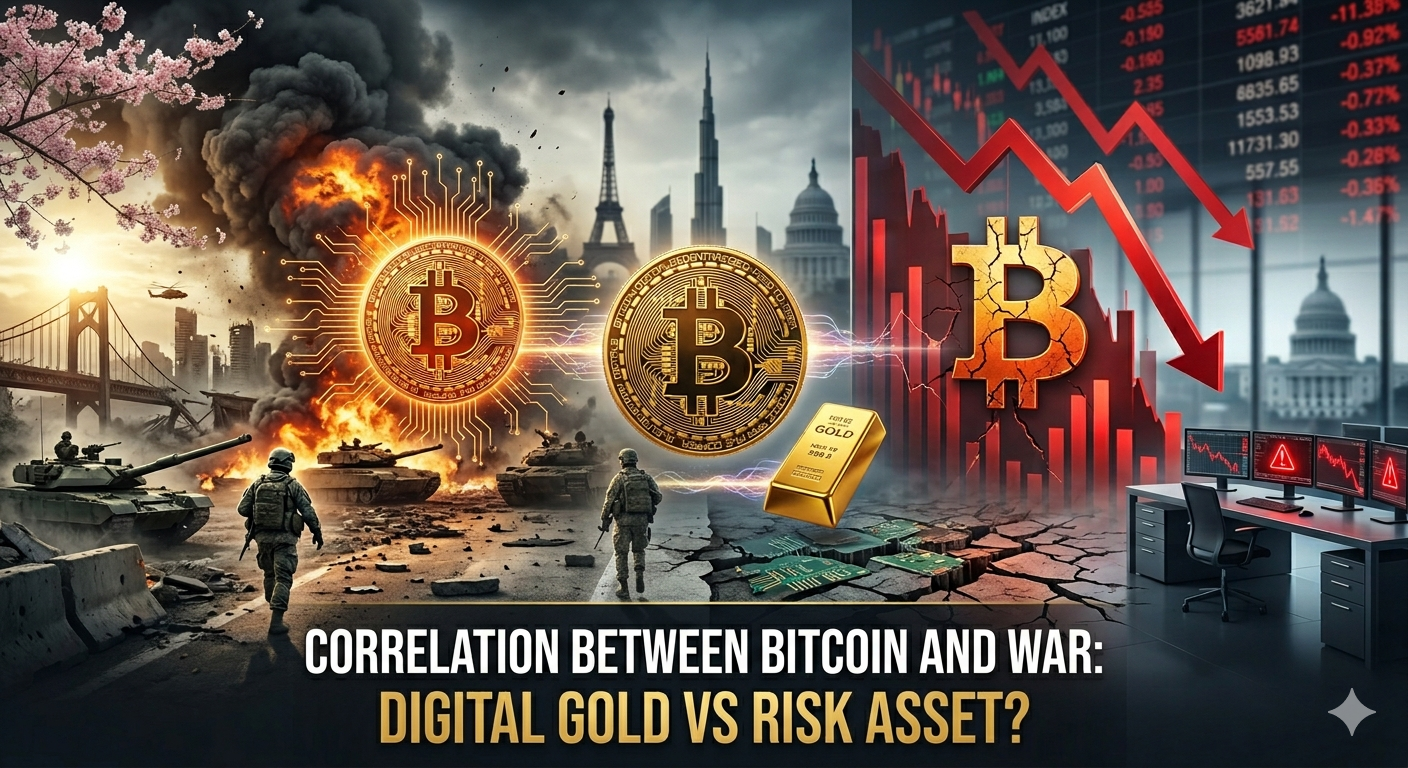
In times of global conflict, investors look for stability. Traditionally, gold has been the go-to safe haven. However, with the rise of cryptocurrency, the Bitcoin and war correlation has become a hot topic in the financial world. Does Bitcoin act as a “digital gold,” or is it just another risky asset that falls when tensions rise?
1. Initial Volatility: The Knee-Jerk Reaction

Historically, at the exact onset of a major military conflict, Bitcoin often experiences a sharp price drop. This is because institutional investors tend to liquidate “risky” assets to hold cash or move into traditional safe havens like gold or treasury bonds. During this initial phase, Bitcoin often behaves more like a high-growth tech stock than a stable store of value.
2. The “Digital Gold” Narrative in Long-Term Crises
Once the initial shock fades, the Bitcoin and war correlation often shifts. In countries directly affected by war, local currencies may collapse due to hyperinflation or bank freezes. In these scenarios, Bitcoin provides a decentralized alternative for preserving wealth and cross-border value transfer. We have seen instances where Bitcoin’s trading volume spikes in regions experiencing geopolitical instability.

3. Censorship Resistance and Financial Sovereignty
War often leads to international sanctions and the freezing of central bank assets. Bitcoin’s decentralized nature means it operates outside the traditional SWIFT system. This “censorship resistance” makes it an attractive tool for both humanitarian aid and individuals seeking to move their life savings across borders when physical banks are closed or destroyed.
4. Impact of Energy and Mining Disruption
Modern warfare can impact global energy prices and internet infrastructure, which are vital for Bitcoin mining. If a major mining hub is located in a conflict zone, the network’s hash rate may drop temporarily. However, Bitcoin’s “Difficulty Adjustment” mechanism ensures the network remains functional even if some miners go offline, proving its technological resilience during wartime.
5. Summary: A Dual Identity
The Bitcoin and war correlation remains dual-natured. Short-term, it often correlates with the stock market’s fear-driven sell-offs. Long-term, it gains strength as a borderless, permissionless financial system. As the world becomes more digitized, Bitcoin’s role as a “crisis hedge” continues to evolve, challenging the traditional dominance of physical gold.